
graph LR
    A["<div style='padding:20px;width:200px;height:auto;background-color:#add8e6;border:2px solid #000;font-size:24px;color:#000;'>Running</div>"]
    <-->
    B["<div style='padding:20px;width:200px;height:auto;background-color:#add8e6;border:2px solid #000;font-size:24px;color:#000;'>Wellbeing</div>"]

    linkStyle 0 stroke-width:2px,stroke:#000,color:#000
Causality
A Primer
Causality
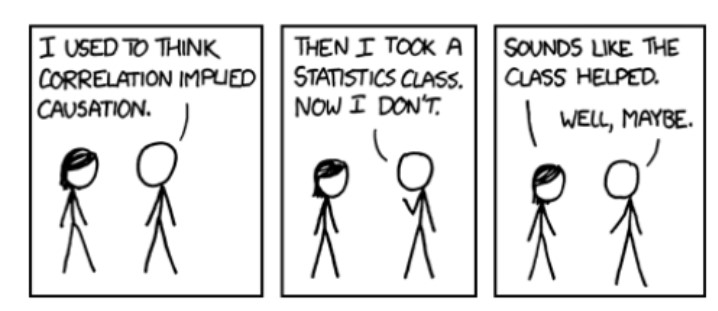
From correlation to causality
- Observation:
- On days where participants go running, they report a better well-being in the evening.
- Interpretation:
- Running is good for your well-being!
- But: Correlation does not imply causation!
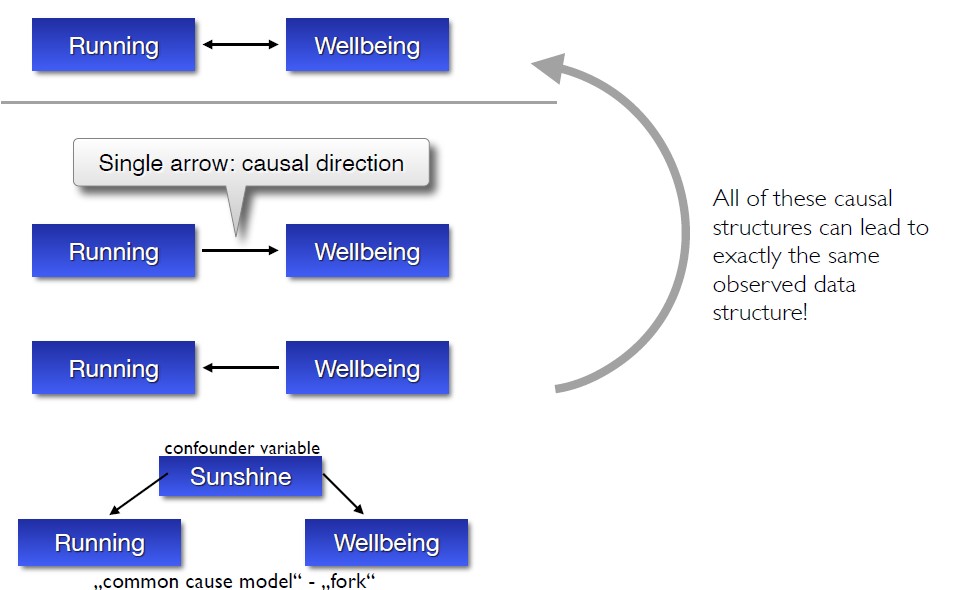
Underlying causal structure
Directed acyclic graphs (DAGs) to represent causal structures
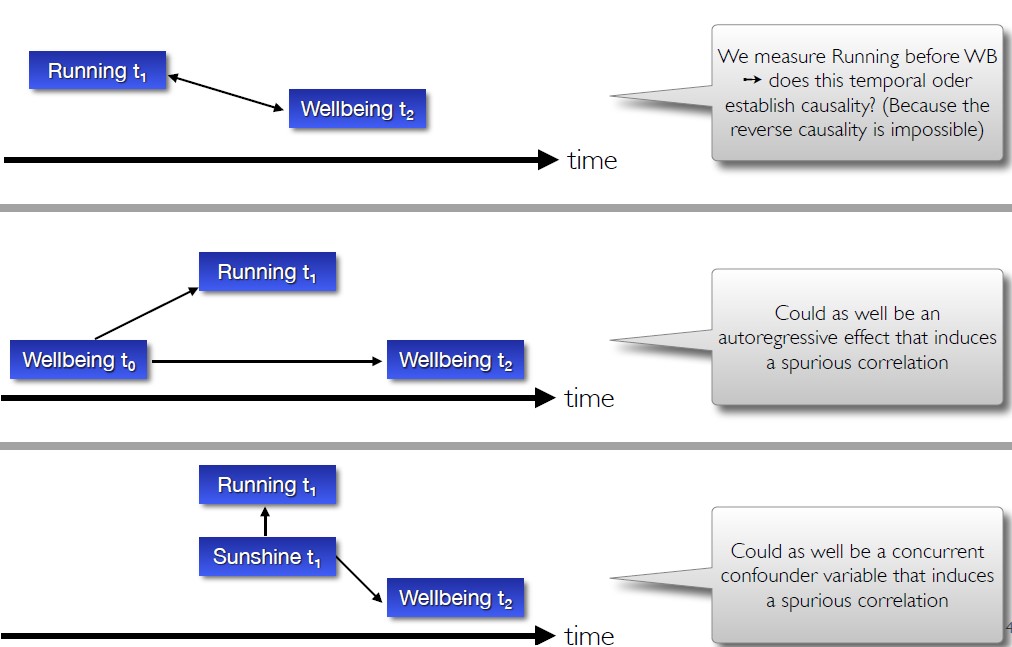
Temporal order to the rescue?
Seeing vs. doing: Observational and interventional inferences
- inferences based on passively observed states of a variable (“seeing”)
- inferences based on the very same state resulting from an external intervention (“doing”)
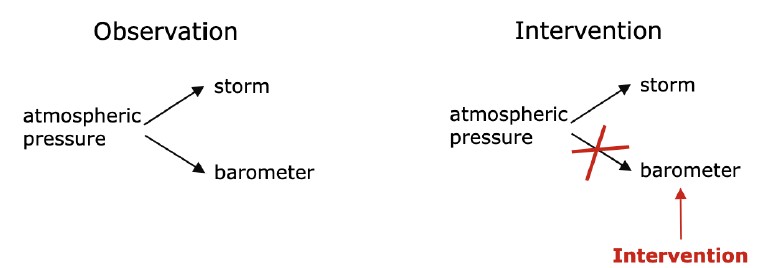
Seeing vs. doing: Observational and interventional inferences
- Reasoning about interventions formalized by Pearl’s (2000) „do-operator“ (cf. Spirtes, Glymour & Scheines, 1993; Dawid, 2002)
- Observational inference: IF B is observed, THEN …
- Interventional inference: IF B is actively generated, THEN …
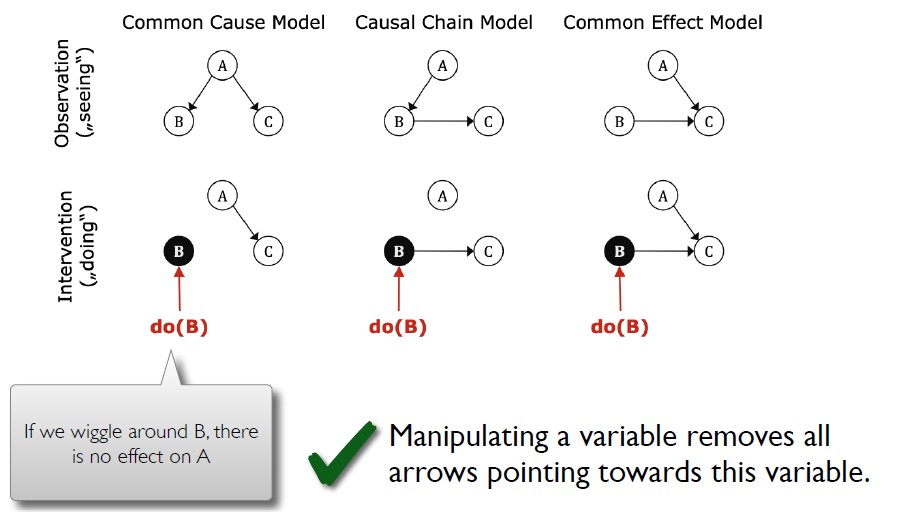
How to rule out alternative causal models?
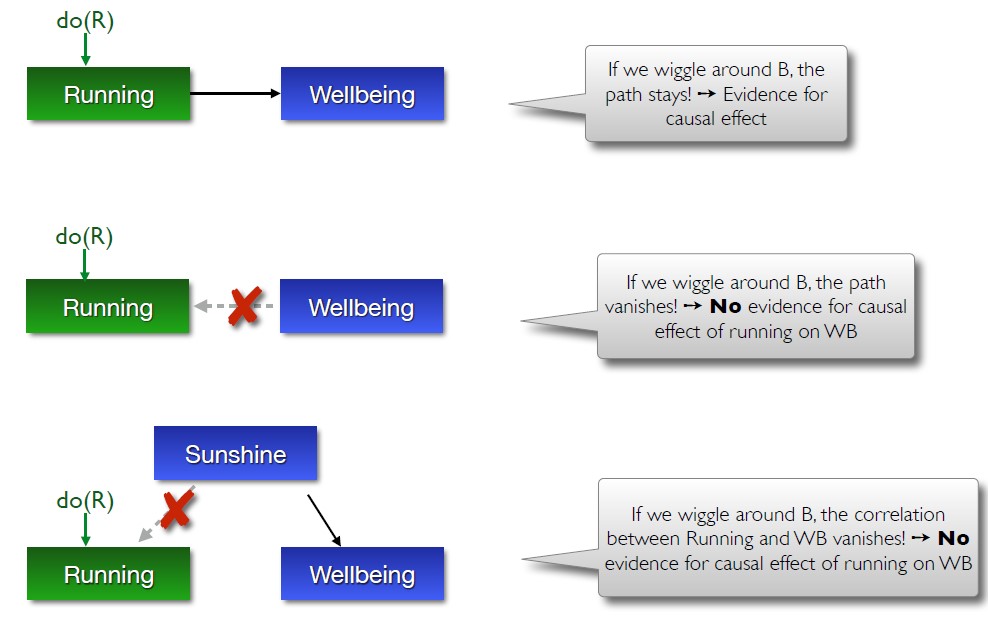
Between-person design

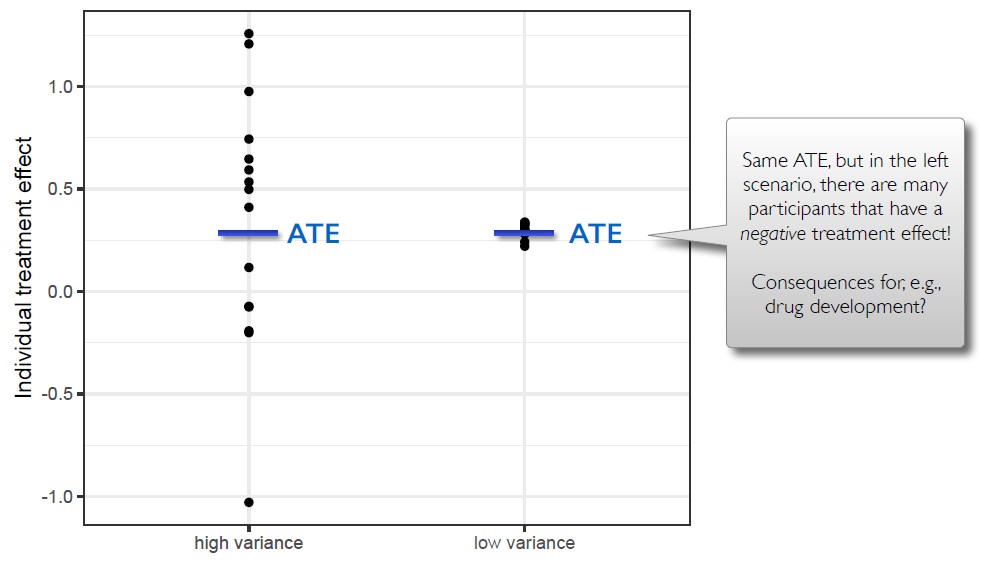
- average treatment effect (ATE), or average causal effect (ACE)
- average across persons: some persons might have stronger effects, others have weaker effects (some might even have no, or a reversed effect). But we cannot estimate this inter-individual variability from this design.
- Statistical test: Simply a t-test, or a regression.
- Note: Often we use the same statistical method for observational and for experimental-data.
Within-person design

- Additional assumptions for within-person designs:
- Temporal stability: The outcome does not depend on the time the treatment is delivered (e.g., maturation effects: first apply control condition, 1 year later the experimental condition ➙ maturation effect can be misinterpreted as treatment effect)
- Causal transience: The treatment effect does not persist beyond the time of outcome measurement (at least, it does not spill over to the next treatment).
- Statistical test: Simply a paired t-test, or a regression.
Assumptions and some pitfalls
Problems of “average”
do(): Fat hand vs. surgeon precision
- Interventions are assumed to be local, i.e., they only affect one single node.
- In practice, we often affect multiple variables at once with an intervention.
- You always get the causal effect for the „full package“ (i.e., all known and unknown differences between control and experimental group). You never know, which component of the package is the actual driver of the effect.
What makes a good control group?
- RQ: Does physical exercise increase wellbeing?
- Treatment: „Doing physical exercises (30 min.) for 7 days“, administered in group training with a certified trainer.
- Outcome: Compare pre vs. post well-being
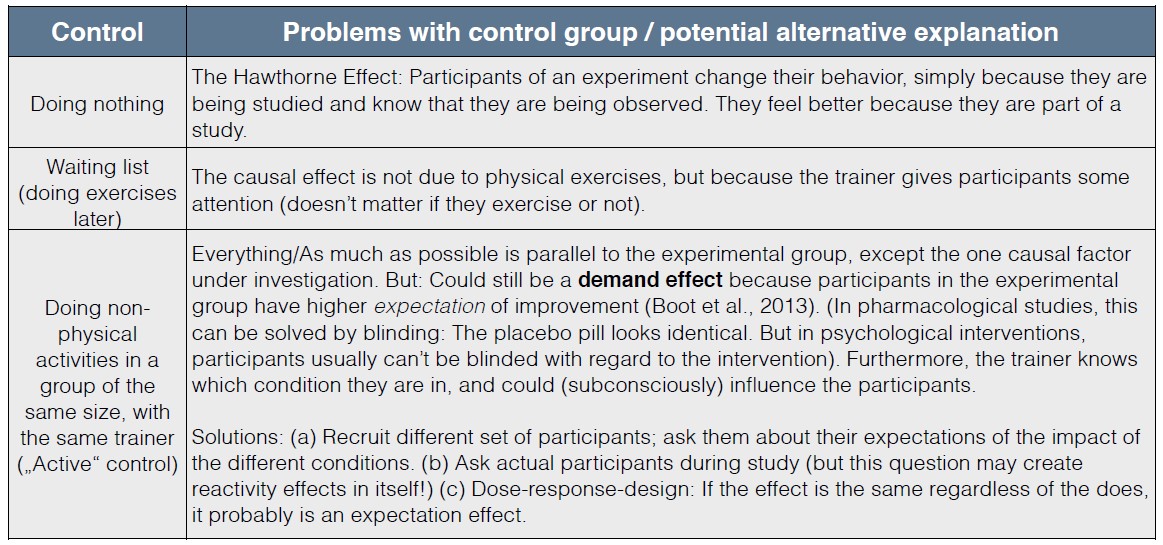
https://doi.org/10.1177/1745691613491271
Why Active Control Groups Are Not Sufficient to Rule Out Placebo Effects.Perspectives on Psychological Science, 8(4), 445–454.
Boot, W. R., Simons, D. J., Stothart, C., & Stutts, C. (2013). The Pervasive Problem With Placebos in Psychology:
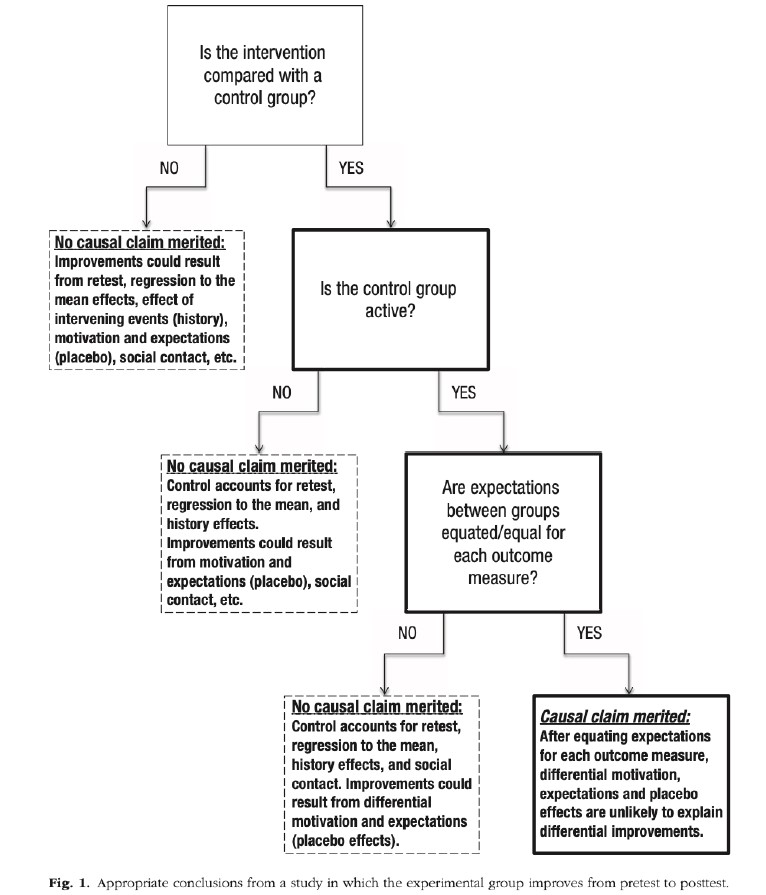
https://doi.org/10.1177/1745691613491271
Why Active Control Groups Are Not Sufficient to Rule Out Placebo Effects.Perspectives on Psychological Science, 8(4), 445–454.
Boot, W. R., Simons, D. J., Stothart, C., & Stutts, C. (2013). The Pervasive Problem With Placebos in Psychology:
Inference of causality is a feature of the experimental design, not of the data analysis.
References
- Maydeu-Olivares, A., Shi, D., & Fairchild, A. J. (2020). Estimating causal effects in linear regression models with observational data: The instrumental variables regression model. Psychological Methods, 25, 243–258. https://doi.org/10.1037/met0000226
- Nahum-Shani, I., Almirall, D., Yap, J. R. T., McKay, J. R., Lynch, K. G., Freiheit, E. A., & Dziak, J. J. (2020). SMART longitudinal analysis: A tutorial for using repeated outcome measures from SMART studies to compare adaptive interventions. Psychological Methods, 25, 1–29. https://doi.org/10.1037/met0000219
- Rosenbaum, P. R. (2017). Observation and Experiment: An Introduction to Causal Inference (Illustrated Edition). Harvard University Press.
- Schmiedek, F., & Neubauer, A. B. (2019). Experiments in the Wild: Introducing the Within-Person Encouragement Design. Multivariate Behavioral Research, 0(0), 1–21. https://doi.org/10.1080/00273171.2019.1627660
- Matthay, E. C., & Glymour, M. M. (2020). A Graphical Catalog of Threats to Validity. Epidemiology (Cambridge, Mass.), 31(3), 376–384. https://doi.org/10.1097/EDE.0000000000001161
- https://egap.org/resource/10-things-to-know-about-the-local-average-treatment-effect/
- https://www.hsph.harvard.edu/miguel-hernan/causal-inference-book/
End
Contact
- @nicebread@scicomm.xyz
- ed.uml.ysp@tdorbneohcs.xilef
- https://www.nicebread.de
- https://github.com/nicebread
